

Asbestos remains a genuine concern across Wollongong and the Illawarra region.
Whether a property is residential, commercial, or industrial, the rules and risks around disposal are the same. This article walks through each situation and helps set the expectation that professional Wollongong asbestos disposal services safely and efficiently make properties safe to use.
If you’re concerned about the presence of asbestos-containing materials (ACMs) in your building, read on to understand how asbestos disposal Wollongong works.
Asbestos in Wollongong: A Local Perspective
Wollongong has a deep industrial and residential history, which helps explain the widespread presence of asbestos-containing materials (ACMs) across the region.
It is estimated that one in three Australian homes contains asbestos, and Wollongong and its suburbs are no exceptions.
Why Is Asbestos So Common Here?
- Wollongong’s industrial past, including steel manufacturing and heavy industry, which relied on asbestos for heat resistance and insulation
- The widespread use of asbestos in building materials from the 1920s through to the early 1980s, when it began to be phased out
- Australia only banned asbestos completely on 31 December 2003, so any property built or renovated before that date may contain ACMs
What Are the Types of Asbestos Found in Local Properties?
- Friable ( or bonded) asbestos fibres are bound within a matrix such as cement or resin; less likely to release fibres under normal conditions, but should still only be handled by professionals
- Friable asbestos is the bad stuff. It crumbles easily and releases fine fibres into the air, which may be inhaled by anyone nearby. It is strictly regulated
- Both types have been identified in buildings and industrial facilities across NSW
What Are the Health Risks?
- Asbestos fibres are invisible to the naked eye and odourless, so accidental exposure is a real risk
- Conditions linked to asbestos exposure include
- asbestosis (scarring of lung tissue)
- lung cancer
- mesothelioma (a cancer of the lining of the lungs and abdomen)
- Symptoms for these diseases may not appear until decades after exposure
- Health effects are generally linked to long-term or repeated exposure, but no safe level of exposure has been established
- Undisturbed ACMs pose minimal immediate risk; the danger arises when materials are damaged, drilled, cut, or demolished
Residential Asbestos Removal and Disposal
Older homes across Wollongong, Shellharbour, Kiama, and the broader Illawarra region often contain asbestos in various locations. Many homeowners only become aware of the issue when planning renovations or preparing a property for sale.
Where Is Asbestos Typically Found in Homes?
- Eaves, fascias, and external cladding (fibro sheeting)
- Roofs, gutters, and downpipes
- Floor tiles and wall sheeting in wet areas such as bathrooms and laundries
- Insulation, especially in ceilings
- Pipe lagging and hot water system surrounds
Do I Need a Licensed Removalist?
- A licensed asbestos removalist must remove any non-friable asbestos area exceeding 10 square metres to adhere to NSW regulations
- As regulated by SafeWork NSW, any amount of friable asbestos must be handled by a Class A licensed removalist
- Homeowners caught trying to remove AMCs themselves or using unlicensed removalists face legal penalties and serious health risks
- Even small amounts should be approached with caution, and professional advice should be sought
How Is Residential Asbestos Disposed Of?
- Waste must never enter the general waste stream or be dumped
- aste must never enter the general waste stream or be dumped
Asbestos waste is sealed by double-bagging or is wrapped in heavy-duty polythene sheeting and labelled - Loads exceeding 100 kg or 10 m² must be registered with the NSW EPA via WasteLocate
- Asbestos waste may only be taken to a disposal site licensed by the NSW Environment Protection Authority
- A clearance inspection and the resulting certificate confirm the area is safe
Commercial Asbestos Removal and Disposal
Across Wollongong, buildings, from retail premises and offices to aged care facilities and schools, are subject to the same legislation as residential properties, but the scope of works and compliance obligations are typically more complex.
What Makes Commercial Jobs Different?
- Big buildings with larger surface areas mean higher volumes of ACMs compared to most residential jobs
- Asbestos registers and management plans for commercial buildings must be maintained by building owners or controllers
- SafeWork NSW must be notified five working days before removal work commences
Air Monitoring and Clearance Certification
- Air monitoring may take place during and after removal to confirm safe fibre levels
- A clearance inspection is conducted by a licensed asbestos assessor, independent of the removalist
- Clearance certificates are legal documents confirming that the site is safe to be reoccupied
- The asbestos register should be updated with details of asbestos removal and disposal
Industrial Asbestos Removal and Disposal
Given Wollongong’s industrial history, older factories, warehouses, and heavy plant facilities often contain large amounts of asbestos, including pipe insulation, gaskets, machinery components, and structural fireproofing.
What Are the Risks in Industrial Settings?
- Industrial ACMs are often friable due to age and physical wear, making them considerably more hazardous
- Workers in maintenance and repair roles have a high risk of exposure
- Disturbing pipe lagging, boiler insulation, or thermal fireproofing without proper controls can cause asbestos fibres to become airborne
- The consequences of a poorly managed industrial removal, including site shutdowns, regulatory penalties, and serious health liabilities for staff, customers and services
Compliance Requirements for Industrial Sites
- Again, only Class A licensed removalists can handle friable asbestos in any setting
- A current and detailed asbestos removal control plan and risk assessment must be maintained
- Containment zones, decontamination units, and negative air pressure enclosures are normally used to protect the larger workforce
- Post-removal air monitoring and clearance certification are required before site activity can restart
Waste Management
- Industrial volumes of asbestos waste require careful pre-removal planning to ensure adequate, secure waste packaging and transport
- All waste must be transported in sealed, labelled containers to an EPA-licensed facility
- Chain of custody documentation should be maintained throughout the process
How Is Asbestos Disposed Of?
The disposal process is heavily regulated in NSW to protect public health and the environment. It is not simply a matter of bagging materials and taking them to a tip. There is a structured, step-by-step protocol that all licensed removalists must follow.
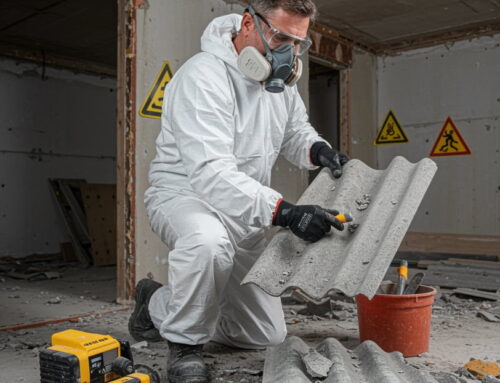
- Site containment: Affected areas are sealed off with plastic sheeting to prevent fibre migration
- Suppression: ACMs are wetted down to reduce the risk of airborne fibre release
- Removal: Materials are carefully detached using appropriate tools to minimise breakage
- Packaging: All waste is sealed securely
- Labelling: Each package is labelled as asbestos waste in accordance with NSW regulations
- Transport: Waste is transported to an EPA-licensed disposal facility
Professional Wollongong Asbestos Disposal Services
For residents and business owners, professional Wollongong asbestos disposal is the only legally compliant and safe option. Handling ACMs without the correct licencing, equipment, and systems puts health at risk and exposes you to legal penalties.
At Wollongong Asbestos Removal, our years of experience mean we have local knowledge of Wollongong-area disposal facilities and regulatory contacts, as well as fully licensed Class A and Class B removal capability.
Visit our asbestos disposal webpage to learn more about our experience and our Wollongong asbestos disposal services.



Leave A Comment